Post Author:
Browne Mortgage Team
Categories:
Date Posted:
February 9, 2026
Share This:
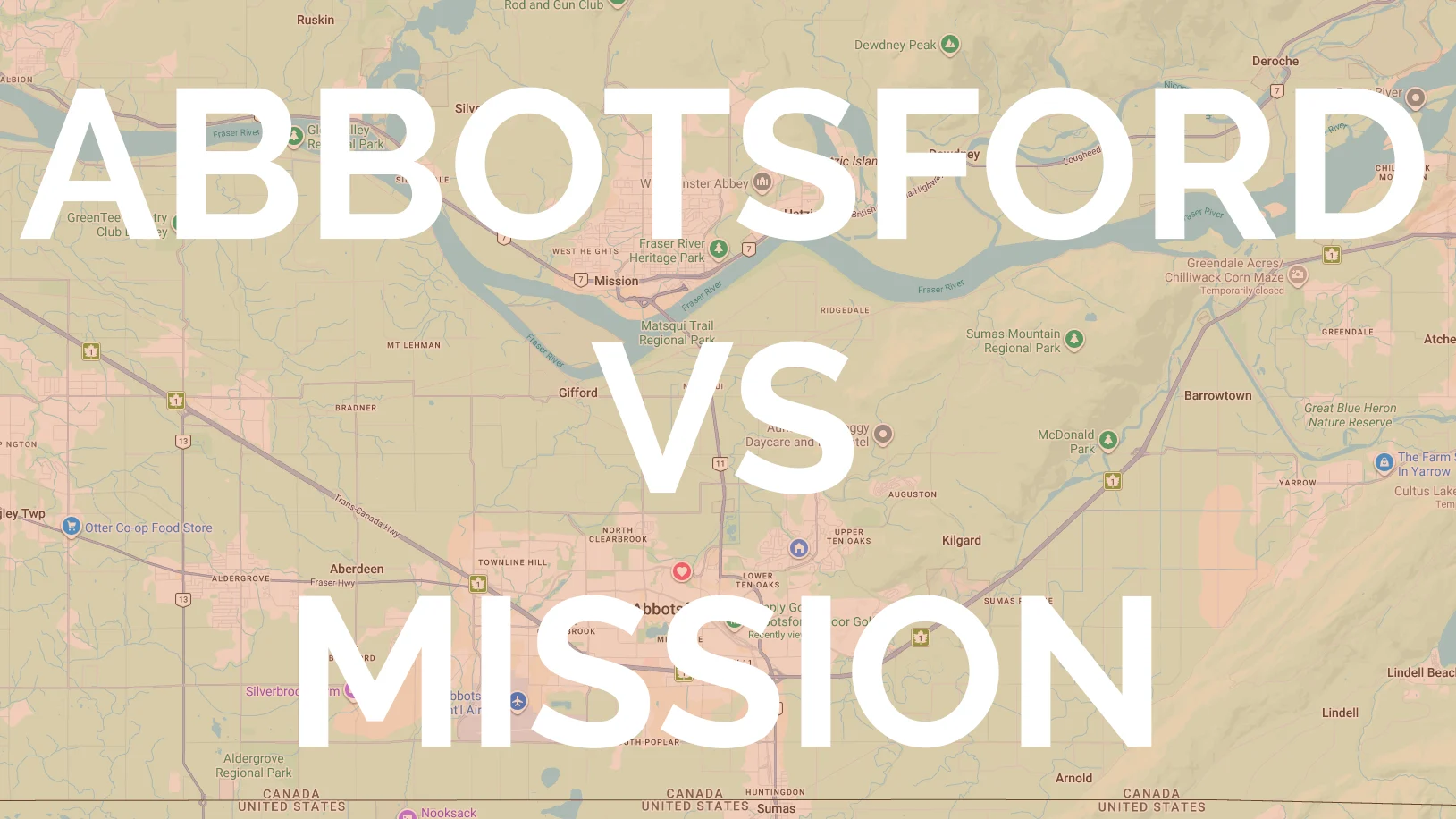
If you’re house hunting in the Fraser Valley, there’s a good chance you’ve narrowed things down to two cities: Mission and Abbotsford. They sit right next to each other on the map, they share a lot of the same Fraser Valley charm, and they’re both places where your dollar stretches further than it would in Vancouver or even Langley. But they’re also genuinely different places to live, and the right choice depends entirely on what matters most to you and your family.
At Browne Mortgage, we help buyers in both cities every week. We have offices in Mission and Abbotsford, and we’ve watched both communities grow and change over the years. This isn’t a “which city is better” article — it’s a practical look at what each one offers so you can figure out which one fits your life.
What Housing Actually Costs in Each City
Let’s start with the numbers, because for most buyers that’s what narrows the search. As of early 2025-2026, a detached home in Abbotsford typically runs between $880,000 and $950,000. In Mission, you’re looking at roughly $750,000 to $850,000 for a comparable property. That’s a meaningful gap — often $100,000 or more — and it shows up across every housing type. Townhomes in Abbotsford range from about $650,000 to $850,000, while Mission townhomes sit closer to $600,000 to $775,000. Condos follow the same pattern: $425,000 to $550,000 in Abbotsford versus $400,000 to $525,000 in Mission.
What does that price difference actually mean for you? On a detached home, the gap between an $850,000 Mission property and a $950,000 Abbotsford one is $100,000. That translates to roughly $10,000 more in down payment (at 10% on the portion above $500K) and around $450 to $500 more per month on your mortgage. Over the life of a 25-year mortgage, that adds up considerably. If you’re stretching to qualify, that difference can be the line between getting approved and not — especially under Canada’s mortgage stress test, which qualifies you at roughly 2% above your actual rate. You can run your own numbers with our mortgage calculator to see exactly where you land.
Neighborhoods Worth Knowing
Abbotsford is a bigger city with more distinct neighborhoods, so let’s break it down. West Abbotsford is the most established and convenient area, with easy Highway 1 access and proximity to shopping along South Fraser Way. Clearbrook, in the central part of the city, offers solid mid-range housing and a strong sense of community — it’s where a lot of families settle. The Mill Lake area is one of the more desirable pockets, with walking trails around the lake and a mix of older character homes and newer builds. Historic Downtown Abbotsford has been slowly revitalizing with local shops and restaurants, though it’s still a work in progress. And then there’s Auguston, up on the hillside in east Abbotsford — a master-planned community with mountain views, parks, and a distinctly suburban feel. It’s popular with families who want newer construction and don’t mind being a bit further from the city centre.
Mission’s neighborhoods have a different flavour. Cedar Valley is the major growth area, with new subdivisions, townhome complexes, and a younger-family vibe. It’s where most of Mission’s new construction is happening. Hatzic, east of downtown along the Fraser River and Hatzic Lake, is quieter and more rural — think acreages, hobby farms, and a slower pace. Silverdale sits between Mission and the river, offering a mix of rural properties and newer developments. Downtown Mission itself is compact and walkable, with a heritage main street that has genuine small-town character — local coffee shops, a few good restaurants, and the Mission Raceway nearby. If you want real acreage, Stave Falls and the areas north of town offer rural living with mountain access, though you’ll be further from services.
Getting Around: Commute and Transportation
This is where the two cities diverge sharply. Abbotsford sits right along Highway 1, which means you have a direct (if often congested) route to Langley, Surrey, and Vancouver. The drive to downtown Vancouver is roughly 75 to 90 minutes in typical traffic. Abbotsford also has its own regional airport and is generally closer to major Fraser Valley services — hospitals, big-box retail, and the like.
Mission is further east and sits on the north side of the Fraser River. Your commute to Vancouver is longer by road — roughly 80 to 100 minutes depending on conditions and which bridge you take. But Mission has a card up its sleeve: the West Coast Express, a commuter rail service that runs from Mission City Station to Waterfront Station in downtown Vancouver. The ride takes about 75 minutes, and for a lot of Mission residents who work downtown, it’s a game-changer. You can read, work, or just sit — no white-knuckle highway driving. The trade-off is that service only runs during peak commute hours (mornings into Vancouver, evenings back out), so it’s not useful for shift workers or people with irregular schedules.
For local errands and day-to-day driving, Abbotsford is simply more convenient. It has more retail, more services, and more options within a shorter radius. Mission residents often find themselves driving to Abbotsford or Maple Ridge for things that aren’t available locally.
Schools and Raising a Family
Both cities have well-regarded public school systems. The Abbotsford School District is one of the larger districts in BC and offers a wider range of programs, including French immersion, Punjabi bilingual programs, and various specialty academies. There’s also the University of the Fraser Valley (UFV) campus in Abbotsford, which is a draw for families thinking long-term about post-secondary options.
The Mission School District is smaller but has a strong community focus. Class sizes can sometimes be smaller, and there’s a sense of everyone knowing each other that you don’t always get in a larger district. Mission also has a campus of UFV, though it’s smaller than the Abbotsford location. Both cities have private school options as well. For families with young children, the practical difference often comes down to which specific school you’d be zoned for rather than district-wide comparisons.
Lifestyle: Urban Convenience vs. Outdoor Access
Abbotsford feels more like a mid-sized city. You have a solid restaurant scene, the Abbotsford Entertainment and Sports Centre, UFV’s cultural events, and the famous Abbotsford International Airshow every August. There’s a growing craft brewery scene, diverse food options reflecting the city’s multicultural population, and more shopping than you’d expect for a Fraser Valley community. Mill Lake Park is a gem for walking and running, and there are plenty of sports leagues and recreational facilities.
Mission leans the other direction. It’s a town that attracts people who want to be outside. Stave Lake and the surrounding Crown land offer hundreds of kilometres of trails for hiking, mountain biking, and off-roading. The Fraser River runs right through the community, and fishing is part of the local culture. Mission’s heritage downtown has a charm that feels authentic rather than manufactured — it’s not trying to be something it isn’t. The annual Candlelight Parade, the farmers’ market, and the community events have a genuine small-town warmth. If your ideal weekend involves trail running, kayaking, or just sitting on a few acres of your own land, Mission is hard to beat.
Investment Potential and Growth
Both cities are growing, but in different ways. Abbotsford’s population has been climbing steadily, driven by immigration, young families priced out of Vancouver, and a diversifying local economy. The city has significant development in the pipeline, including new townhome and condo projects along the South Fraser Way corridor and continued expansion in east Abbotsford. According to Statistics Canada census data, Abbotsford has been one of the faster-growing municipalities in BC, and that trend shows no sign of slowing.
Mission’s growth has been more modest but is picking up, particularly in Cedar Valley where new housing is attracting younger buyers. Mission’s appeal as a more affordable alternative to the rest of the Lower Mainland gives it a built-in demand driver. Property values have appreciated well over the past decade, and as affordability pressure continues to push buyers eastward, Mission stands to benefit. The city has also been investing in its downtown core and infrastructure, which should support long-term value. BC Assessment data shows steady assessed value increases in both communities, though Abbotsford’s larger and more liquid market tends to recover faster after downturns.
How the Price Difference Affects Your Mortgage
Here’s something a lot of buyers don’t think about until they’re sitting across from a mortgage broker: a $100,000 price difference doesn’t just mean a cheaper house. It changes what you qualify for, how much cash you need upfront, and how much breathing room you have in your monthly budget. Under Canada’s stress test rules, you need to qualify at a rate roughly 2% above the rate you’ll actually pay. On a $950,000 Abbotsford home, the income required to qualify is meaningfully higher than on an $850,000 Mission home — we’re talking roughly $15,000 to $20,000 more in household income needed.
If you’re a first-time buyer, that gap matters even more. You may have been saving for years, and the difference between needing a $70,000 down payment versus an $85,000 one could be another year or two of saving. Before you fall in love with a neighbourhood, it’s worth getting a clear picture of what you can actually afford. A mortgage pre-approval takes the guesswork out of it and gives you a real number to work with.
So, Which City Is Right for You?
Choose Mission if you’re budget-conscious and want more house for your money. If you work remotely (or can handle the West Coast Express commute), if you value outdoor recreation and space over urban convenience, and if you’re drawn to a tight-knit community feel — Mission is likely your place. It’s also worth a serious look if you want land, whether that’s a larger lot, a hobby farm, or just room for the kids to run around.
Choose Abbotsford if you need to be closer to Highway 1 and the broader Fraser Valley job market. If you want more dining, shopping, and entertainment options close to home, if you have kids who’d benefit from a larger school district’s program variety, or if you’re looking at real estate partly as an investment and want a larger, more active market — Abbotsford is the stronger fit. It’s also the better base if you regularly need to get to Langley, Surrey, or other Valley communities.
And honestly, plenty of people look at both before deciding. If you’re in that camp, we’d encourage you to read our broader guide comparing Abbotsford, Chilliwack, Mission, and Langley for even more context.
Ready to Talk Numbers?
Whether you’re leaning toward Mission or Abbotsford — or still deciding — the smartest first step is understanding exactly what you can afford. Our team works with buyers in both cities every day, and we can walk you through what the numbers look like for your specific situation. Reach out to our Abbotsford office at 604-850-5877 or connect with our Mission mortgage team directly. No pressure, no jargon — just a clear picture of your options.