Post Author:
Browne Mortgage Team
Categories:
Date Posted:
February 6, 2026
Share This:
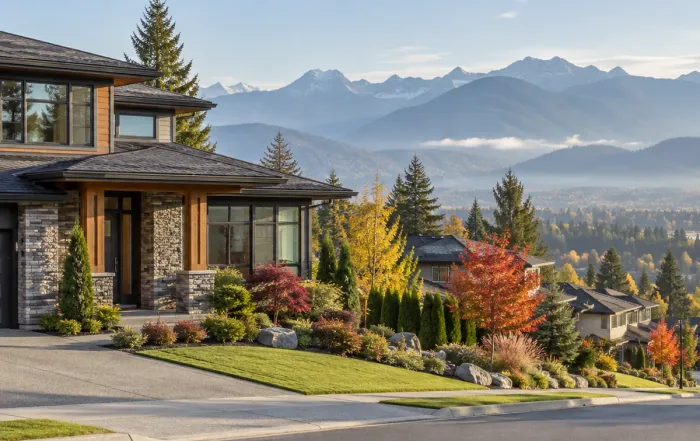
Cedar Valley has transformed Mission’s housing landscape. What was forested hillside a decade ago now holds streets of contemporary homes with mountain views, modern amenities, and designs built to current energy codes. Combined with smaller infill projects closer to downtown and scattered custom builds throughout the district, Mission offers first-time and move-up buyers genuine choice in new construction. Financing these purchases, though, follows a different path than buying a resale home.
Mission’s New Construction Landscape
Unlike larger Fraser Valley cities with multiple major developments competing for buyers, Mission’s new construction concentrates primarily in Cedar Valley, with supplemental projects in select locations. This creates a distinct dynamic.
Cedar Valley: Mission’s designated growth area offers phased residential development including single-family homes, townhome complexes, and some duplexes. The area features newer infrastructure, parks, trails connecting to the broader community, and mountain views that improve as you climb the hillside. Prices range from the high $500,000s for townhomes to $900,000 or more for larger detached homes on premium lots.
Downtown infill: As Mission’s core revitalizes, older lots are being redeveloped into small townhome projects and duplexes. These bring modern construction to walkable locations near shops, schools, and the West Coast Express station. Infill projects tend to be smaller – 6 to 20 units – with shorter construction timelines.
Custom builds: Buyers with land in Hatzic, Silverdale, or other areas sometimes build custom homes. This involves construction mortgages with draw schedules rather than standard purchase financing, adding complexity but giving full control over the final product.
Pre-Sale vs. Move-In Ready: Two Financing Paths
Pre-Sale Purchases
Buying pre-sale means signing a contract with a builder before the home is finished, sometimes before ground is broken. You select a lot, choose finishes from the builder’s options, and wait months for completion. Your deposit is held in trust, and you arrange final mortgage financing as the completion date approaches.
The appeal of pre-sale includes choosing your preferred lot and floorplan, customizing finishes before construction begins, time to build additional savings while waiting, and potential appreciation if the market rises between contract and completion.
The risks include construction delays from weather or supply issues, interest rate changes between signing and closing, market shifts that could push values below your contract price, and the need to keep your financial profile stable for the duration.
Completed Inventory
Move-in ready new homes – spec builds or completed inventory – let you see exactly what you’re buying. Financing works like a standard purchase: arrange a mortgage, close within 30 to 60 days, move in. No construction wait, no rate uncertainty.
The tradeoff is limited customization (the builder already made finish choices) and fewer lot options. In Cedar Valley, completed inventory tends to move quickly, particularly homes in the mid-price range.
How Builder Deposits Work
Pre-sale contracts require deposits in stages as construction progresses. A typical structure in Mission:
Contract signing: $5,000 to $10,000 initial deposit, held in trust by the builder’s lawyer.
30 to 60 days later: A second deposit bringing the total to 10% of the purchase price.
At framing stage: A third deposit bringing the total to 15% to 20%.
On a $750,000 home, total deposits might reach $112,500 to $150,000 over several months. These funds must be liquid and accessible when each payment comes due – not locked in GICs, RRSPs, or other investments you can’t quickly access.
All deposits are credited toward your down payment at closing. You don’t lose this money; it becomes equity in your new home. But the staged requirement means you need a savings plan that accounts for each deadline.
Locking In Your Rate Before Completion
Standard mortgage pre-approvals hold rates for 90 to 120 days. If your new home won’t be ready for 8 to 14 months, that rate hold expires well before you need the mortgage.
Some lenders offer extended rate holds up to 12 or even 18 months for pre-sale purchases. These protect you if rates rise during construction, and if rates drop, you typically get the lower rate instead. Extended holds aren’t available from every lender – ask your broker which options exist and what conditions apply.
To secure an extended hold, you’ll typically need the signed builder contract, estimated completion date, and proof of deposits already made.
Keeping Your Financing Intact During Construction
Between signing a pre-sale contract and closing on the completed home, your financial life needs to stay stable. Lenders re-verify everything 30 to 60 days before closing: income, employment, credit, and debts.
Actions that can jeopardize your approval during this period:
- Changing jobs or employers (even for higher pay, this creates uncertainty for lenders)
- Taking on new debt – car loans, furniture financing, increased credit card balances
- Co-signing loans for family members
- Making large, unexplained deposits into your bank accounts
- Missing payments on existing debts
If your qualification weakens between contract and closing, you could face a reduced mortgage approval or outright denial, putting your deposits at risk. Treat the construction period as a financial holding pattern.
Construction Delays: Planning for the Real Timeline
Builder contracts include estimated completion dates, but delays are common across the industry. In Mission, wet winter weather, supply chain variability, municipal inspection schedules, and labour availability all push timelines.
Most contracts include sunset clauses allowing the builder to extend completion by 6 to 12 months without penalty. If delays exceed the sunset period, you may be able to cancel and recover deposits, but that leaves you without a home after months of waiting.
Practical steps to manage delay risk:
- Don’t sell your current home or end your lease until the builder confirms a firm completion date
- If the builder estimates spring completion, plan your life around summer
- Maintain flexibility in your living arrangements
- Keep communication open with your mortgage broker – if your rate hold is expiring, they may be able to arrange an extension or new approval
GST on New Construction
New homes attract 5% GST on the purchase price. On a $750,000 home, that’s $37,500 in GST. The federal GST New Housing Rebate refunds a portion for homes under $450,000, but most Mission new builds exceed that threshold, making the federal rebate unavailable. BC offers a separate provincial new housing rebate that may apply.
Most builders include GST in the advertised price and handle rebate applications on your behalf, crediting any rebate at closing. Before signing, confirm whether the contract price is GST-inclusive or GST-additional. If GST sits on top of the contract price, your total cost and down payment requirements increase accordingly.
Lenders don’t separately finance GST. If the total cost including GST exceeds your mortgage amount, you cover the difference from your own funds.
Warranty Protection on New Builds
Every new home in BC carries mandatory warranty coverage through the Home Owner Protection Office:
- 2 years: Materials and labour defects, including finishes, appliances, and fixtures
- 5 years: Building envelope protection against water penetration through exterior walls and roof
- 10 years: Structural defects in foundation, framing, and load-bearing components
Before your first-year warranty expires, walk through the home carefully and document every deficiency, no matter how minor. Builders are obligated to address warranty claims within the coverage period, but issues reported after the deadline become your expense.
Appraisal Considerations
Appraisers value new construction by comparing your purchase price to recent sales of similar new homes. In Cedar Valley, where development has been ongoing for several years, comparable sales are generally available and appraisals typically support contract prices.
Appraisal risk increases when you’re buying in a newly opened phase with no nearby sales to reference, the market softens between contract signing and completion, or you paid premiums for a view lot or extensive upgrades that aren’t fully reflected in comparable sales.
If the appraisal comes in below the contract price, you’ll need to increase your down payment to cover the gap (builders rarely renegotiate) or potentially walk away and lose deposits. Maintaining a financial buffer beyond minimum requirements provides protection.
First-Time Buyers and New Construction
First-time buyers purchasing new construction can access 30-year amortization periods, reducing monthly payments compared to the standard 25-year schedule. This can improve qualification or simply lower the monthly cost of homeownership.
The First Home Savings Account (FHSA) and Home Buyers’ Plan (HBP) can be used toward new construction deposits and down payments. If you’re planning a pre-sale purchase 12 to 18 months out, that timeline gives you additional contribution room in your FHSA to build your down payment.
BC’s property transfer tax exemption for first-time buyers applies to qualifying new homes, though most Mission new construction prices exceed the full exemption threshold.
Custom Builds and Construction Mortgages
Buying a lot in Mission and building a custom home involves construction mortgage financing rather than a standard purchase mortgage. Construction mortgages release funds in draws as building progresses – typically at foundation, framing, lock-up, drywall, and completion stages.
Construction mortgages carry higher rates than standard mortgages and require:
- Detailed construction plans and building permits
- A fixed-price contract with a licensed builder
- An appraisal based on the completed home’s projected value
- A down payment of 20% or more (most lenders require this for construction loans)
Upon completion, the construction mortgage converts to a standard mortgage at prevailing rates. This two-phase process requires more planning than a standard purchase but gives you complete control over the finished home.
Choosing the Right Approach
New construction suits buyers who want modern energy efficiency and building standards, prefer to choose finishes and customize their home, can manage the financial planning of staged deposits, have stable employment and income during the construction period, and are comfortable with timeline uncertainty.
It may be less suitable if you need to move immediately, prefer established neighbourhoods with mature landscaping and larger lots, want to avoid the risk of construction delays or rate changes, or are working with a tight budget where any financial disruption creates problems.
For many Mission buyers, townhomes in Cedar Valley offer an accessible entry point into new construction at lower price points than detached homes.
Getting Pre-Approved for New Construction
Secure pre-approval before visiting sales centres or signing builder contracts. Knowing your maximum purchase price, understanding rate hold options, and having documentation ready lets you act quickly when the right home or lot becomes available.
For guidance on new construction financing in Mission, including extended rate holds and builder contract review, contact our team at 604-820-5626. We work with Mission’s active developments and know which lenders offer the best programs for new builds.